
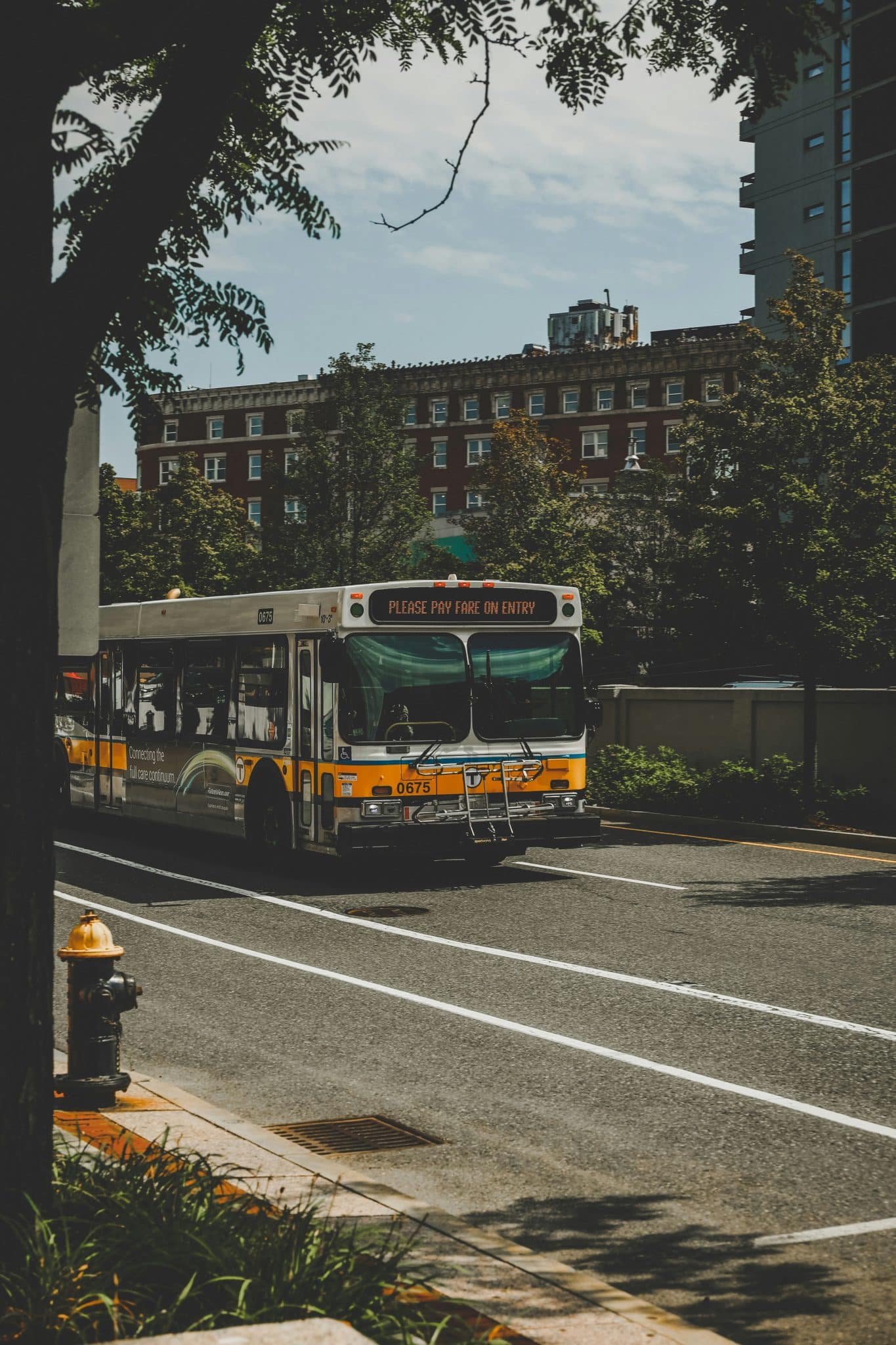
In Boston, it’s a common commute: a passenger of the Massachusetts Bay Transportation Authority (MBTA) can take a trip through the oldest operating subway tunnel in North America paid for with their CharlieCard, an homage to a classic 1948 campaign song. While the MBTA prides itself on its long history, the agency—which operates subways, commuter rail, buses, and ferries across 84 municipalities—is also looking toward the future.
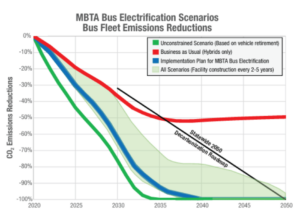
Last year, the agency ordered 80 40-foot battery-electric transit buses (BEBs) as part of its Bus Electrification Plan. Released in May 2022, the plan seeks to transition the MBTA’s 1,150 buses to a zero-emission fleet by 2040 as part of the Massachusetts 2050 Decarbonization Roadmap.
This move comes amid a nationwide trend. The number of full-sized, zero emission transit buses funded, ordered, delivered, or deployed by transit agencies in the United States has more than doubled since 2020. By this metric, Massachusetts is a forerunner with the fifth most full-size BEBs in the pipeline behind California, New York, Florida, and Washington.
Early stages of the MBTA’s plan were fully funded as of 2022, though the future funding environment for BEBs is unclear amid shifting federal priorities. Realizing this plan will require billions—each bus facility revamped to support BEBs will cost $300 million or more, and each of the recently purchased buses cost about $1.4 million. The Federal Transit Administration’s Low or No Emission (Low-No) grant program supported the MBTA’s recent vehicle purchase and is one of two major federal grant programs that have historically funded BEB purchases. Local funding may also be available. The Massachusetts Clean Energy Center provides grants for zero-emission transportation and the MBTA is exploring opportunities for public-private partnerships and joint development.
Like in many transit agencies, buses are the workhorse of the MBTA system. The MBTA operates 170 bus routes across 44 cities in Greater Boston. Each weekday, passengers take approximately 800,000 trips on MBTA service with about 38 percent of these trips on buses, the second most popular mode behind the subway. The bus network disproportionately serves minority and low-income passengers, and, during the pandemic, bus ridership remained resilient, declining less than other modes.
This isn’t the MBTA’s first foray into electric buses. For eight decades, a fleet of electric trolleybuses operated on Greater Boston streets receiving power from overhead wires. In 2022, the remaining 28 trolleybuses were temporarily replaced by diesel-electric buses to support the installation of BEB infrastructure. While the trolleybuses were fully electric, the MBTA believes the power source, overhead wires, were less preferable than newer battery technologies. In evaluating the options, the MBTA found trolleybus infrastructure has a higher lifecycle cost than BEBs, and little, if any, ability to adapt to roadway blockages.
Prior to the current electrification plan, the MBTA trialed low or zero emission buses. In 2010, The agency purchased its first diesel-electric buses and now operates 480 of these vehicles throughout the system. In 2016, the MBTA piloted, but did not adopt, hydrogen fuel-cell buses. Three years later, the agency purchased five 60-foot BEBs to evaluate performance in different operating conditions, including the harsh New England winter.
This wintery mix — batteries and cold weather — has its challenges. On cold days, bus batteries both power and heat the vehicles, limiting the miles they can travel before charging. A 2021 report informed by the 60-foot BEB trials proposed several solutions: schedule additional buses to support operations on the coldest days, use a larger and heavier battery, add charging infrastructure throughout the route, or install auxiliary diesel-fueled heaters on BEBs. In the short term, the MBTA plans to install auxiliary heaters with the eventual goal of building out infrastructure to provide on-route charging, according to the Bus Electrification Plan.
Charging infrastructure is necessary to make the buses, and plan, go. At least in the early stages of implementation, the buses will charge at the MBTA’s nine bus facilities. These facilities each support a set of routes and must be rebuilt or renovated to accommodate BEB charging alongside other improvements. The MBTA prioritized bus facilities for renovation based on operational needs and equity with the goal of accelerating the reduction of greenhouse gas emissions in low-income areas and communities of color. In addition to the retrofit of the North Cambridge Bus Maintenance Facility, the new Quincy Bus Facility is under construction and the Arborway Bus Facility is in design.
Modernized facilities will allow the purchase and operation of BEBs. If all goes to plan, more than half the fleet will be battery-electric by 2030. More bus facilities are expected to come online every two to three years through 2040, allowing for the rollout of electric buses on all routes.
Moving Cities is a series of posts dedicated to exploring the vast diversity of cities and how their transit systems shape them. Moving Cities examines the organizational structure of transit in relation to the city, the economics of the transit system, and the role of the transit system in the economics of the city, and last, but certainly not least, the experience of the city from the perspective of the transit user.
Elizabeth Dobbins, Lead Analyst | [email protected]

Elizabeth Dobbins is a lead analyst at Econsult Solutions, Inc (ESI). She brings experience in journalism and urban planning. Ms. Dobbins graduated from Oberlin College with a bachelor’s degree in English and the University of Pennsylvania with a master’s degree in City Planning, concentrating in Housing, Community and Economic Development. While at Penn, she interned for the City of Philadelphia’s Office of Transportation, Infrastructure and Sustainability (OTIS). In this position she focused on transportation projects, working at the nexus of community engagement and implementation.