
The Philadelphia Taking Care of Business Clean Corridors Program plays a critical role in strengthening neighborhood commercial corridor districts through consistent cleaning paired with a unified approach to performance measurement. Through this initiative, the Department of Commerce funds community-based nonprofits to sweep sidewalks, remove litter, and maintain commercial corridors within the city.
The program has four primary goals:
- Maintain clean commercial districts in Philadelphia neighborhoods.
- Promote the economic success of neighborhood businesses by creating an inviting environment for shoppers.
- Create work opportunities for Philadelphians.
- Grow the capacity of small local businesses and organizations that provide cleaning services.
Since 2021, ESI has partnered with The Intersect to support Commerce in advancing these goals. ESI developed and continues to refine a structured approach to measuring program performance, ensuring that results remain consistent, transparent, and adaptable as the city expands the initiative into additional corridors.
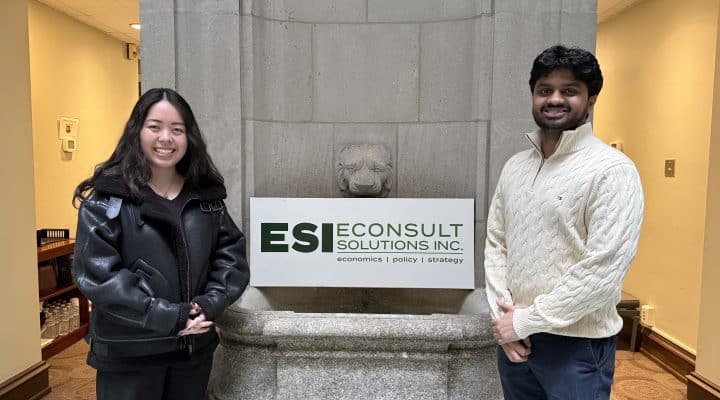
ESI Research Assistants My Nguyen and Harsha Ramachandran share insights into the program, our team’s analytical process, and lessons other cities can draw from this unique public-private partnership model.
What is the Taking Care of Business program? What’s the overall goal and how does it improve the lives of Philadelphia residents?
My: Our team supports the initiative by conducting statistical analysis and producing mapped visualizations that help translate data into measurable results. The Litter Index is at the center of the program. This assessment tool is a standardized, point-in-time cleanliness measure that allows the city to evaluate changes over time and across different geographies. For Philadelphia residents, this translates into cleaner blocks where people shop, commute, and spend time. It also creates clearer accountability by showing where conditions are improving and where additional attention is needed. Pairing corridor cleaning with consistent measurement ensures that public investment leads to visible and trackable progress.
Harsha: The impact is straightforward. Cleaner corridors strengthen neighborhood commercial districts, welcoming shopping, commuting, and local activity while supporting small businesses. A consistent measurement framework helps the city understand what is working, identify areas for improvement, and allocate resources where they can have the greatest impact.
What work does ESI perform on behalf of the city in assessing the Taking Care of Business Program? What support do we offer?
Harsha: Both raw and aggregated data, including Citywide, corridor-level, and cleaning organization averages, are analyzed to assess trends and performance over time. Maps and GIS files are developed to illustrate cleanliness conditions and allow for visual comparisons across corridors. Summary memos are distributed and explain the methodology, report partner scores, and highlight changes from prior periods, supported by data tables and mapped visuals. Program-wide statistics are prepared for the Department of Commerce to support Citywide oversight and performance tracking. At the same time, tailored metrics are developed for individual cleaning organizations and neighborhoods to strengthen corridor-level accountability.
What was the central objective of this analysis? How did your efforts support the team in advancing the project and meeting goals?
My: For the summer season, the assessment covered 1,700 blocks across 412 cleaning areas, with 5,145 total assessments. These corridors span Philadelphia’s key commercial stretches in neighborhoods where residents shop, commute, and spend time, which made consistency and quality control especially important. The team assisted with data processing and analysis across approximately 1,700 blocks, calculating average Litter Index ratings by block as well as organization-level averages for 52 cleaning organizations. Building on that analysis, we developed summary metrics, including the share of blocks at manageable versus undesirable litter levels and descriptive information on the distribution of litter types by block. To translate these findings visually, ESI produced maps for the 52 participating community cleaning organizations, showing block average scores for the summer program.
Harsha: We helped in translating the data into visual analysis and written materials to support participating organizations and the Department of Commerce. We were also able to support production of fall-average and annual-average maps for each organization, resulting in 104 total maps showing block-level performance consistently.
In parallel, we supported the preparation and editing of organization memos for 52 organizations for both the fall season and the full program year. Additional summary measures were created to show the share of blocks at manageable versus undesirable litter levels and distribution of litter types. These measures helped keep the analysis aligned with the program’s goals.
What can other cities learn from Philadelphia’s Taking Care of Business program?
My: Pairing corridor cleaning investments with a standardized, repeatable measurement system creates accountability and makes it easier to track progress across neighborhoods and seasons. Just as importantly, this is the kind of model that can transfer well: a city can adopt the same measurement-and-reporting approach, then work with an organization like Econsult Solutions, Inc. to conduct the assessments, manage the data, produce maps, and deliver clear memos that partners can use to improve results over time.
Harsha: Clear data and visuals also improve accountability and make it easier to communicate results to partners and the public.
Taking Care of Business represents a scalable, data-driven model for urban corridor revitalization that integrates cleanliness, workforce development, and environmental stewardship into a single coordinate strategy. The program demonstrates how targeted operational investments can produce measurable improvements in areas that anchor local economies.
Beyond beautification, the program reinforces that cleaner streets and maintained vacant lots reduce blight, discourage illegal dumping, and enhance public safety, conditions that make commercial districts more attractive to residents, visitors, and investors. As cities nationwide grapple with downtown reinvention, Philadelphia’s approach offers a replicable framework for aligning public services, community partnerships, and performance metrics to drive long-term revitalization.