
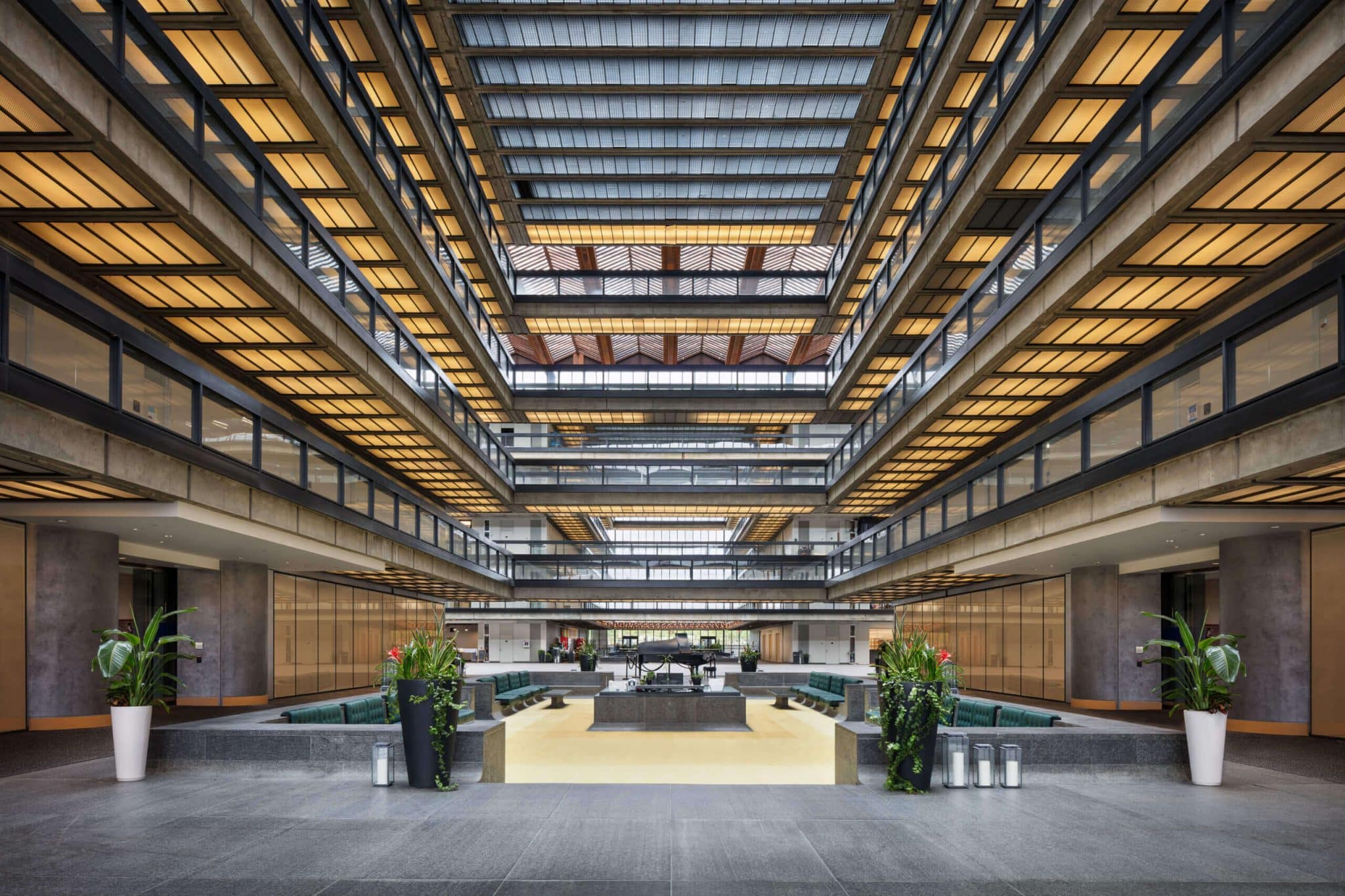

The intersection of innovation and arts and culture is a hot topic today, but it isn’t a new idea. In the 15th century, the Medici family’s patronage brought painters, sculptors, and early scientists into the same social orbit in Florence, a collision of disciplines that historian’s credit with helping spark the Renaissance. In the mid-20th century, Bell Labs designed a corridor longer than two football fields to encourage physicists and chemists into daily contact, a layout credited as a contributing factor behind the development of the transistor and multiple Nobel Prizes. Present day, CERN runs a formal artist residency, placing more than 250 artists alongside physicists, doing so since 2012, with the premise that exposure to frontier science shapes creative work, and vice versa. Three very different eras point to the same conclusion: the intersection of arts and science produces better ideas in proximity rather than in isolation.
Cortex Innovation Community in St. Louis, uCity Square in Philadelphia, Hub RTP in North Carolina’s Research Triangle Park, and SkySong in Scottsdale, Arizona are modern experiments in that same vein. Each integrated placemaking into its long-term attractiveness strategy with deliberate investment in art, culture, and ground-floor activation.
Cortex Innovation Community: Identity Built into the Ground Plane
 In St. Louis, the five-institution partnership behind Cortex treated Cortex Commons, its central plaza, as a core component of its identity, integrating placemaking principles throughout. The plaza’s paving pattern was designed around a DNA sequence, a nod to the district’s bioscience tenants, and its Corten steel retaining walls reference the site’s industrial past. Cortex also ran a formal public art commission for its parking garage facade, drawing finalists including sculptor Cliff Garten and muralist William LaChance, judged by a panel from the Saint Louis Art Museum and the Pulitzer Arts Foundation. And the district co-founded Murmuration, a festival explicitly fusing “science, technology, art and music,” and preserved two historic industrial buildings, including a 1930s printing plant whose pulleys and rail systems remain visible, inside the renovated lab space. All these investments point to an understanding that integrating art and culture will help science and innovation thrive, by creating a place that people want to in and around.
uCity Square: Art Build From Community Memory
 In Philadelphia, developer Wexford Science & Technology used ground-floor retail to accelerate leasing. But its most distinctive placemaking investment is “Ascendance,” a 2024 sculpture and soundscape by artist Nina Cooke John, developed with Mural Arts Philadelphia and built directly from oral histories collected at community block parties in Mantua, Belmont, and the historic Black Bottom neighborhood, and also integrating handmade clay tiles made by residents. It joins at least six other public artworks across the district predating it, including Leo Villareal’s 3,600-LED canopy and glass and light installations by Soo Sunny Park and United Visual Artists exploring the parallels between art and science. “The Lawn,” the district’s public plaza, hosts free weekly programming that keeps the district active outside standard office hours. The path that uCity Square followed is instructive: activation here serves two purposes, both attracting leasing and reengaging the surrounding neighborhood community.
Hub RTP: An Art Program Written into the Investment Strategy
 Research Triangle Park had no on-site retail, dining, or public art for most of its 65-year history. That changed with the development of Hub RTP, its $1.5 billion mixed-use addition, which includes a dedicated art program with a 21-piece collection and an Outdoor Murals Project commissioning regional artists across eleven sites, alongside a permanent outdoor stage hosting a free recurring concert series and an annual Juneteenth festival. New restaurants and retail were chosen, in an investor’s words, to serve the broader area rather than only new residents, and the district’s greenspace remains open to RTP’s existing workforce of 55,000 employees rather than gated to new tenants. Early office leasing has followed, including Genesys and the law firm K&L Gates relocating into Hub RTP’s first building.
SkySong: A Plaza Built for the Desert
 Arizona State University, the City of Scottsdale, and master developer Plaza Companies built SkySong on 42 acres of a former dead mall, anchoring it with a 50,000-square-foot “shade sail” plaza, eight tensile fabric canopies rising 150 feet, designed as much for heat mitigation as for gathering space. In 2020 the district added “Sunburst,” a suspended stainless-steel-and-glass sculpture by artists Shane Allbritton and Norman Lee, funded jointly by the ASU Foundation and the City of Scottsdale. Plaza Companies CEO Sharon Harper described the results clearly: “Even when it’s 115 degrees, there are people sitting in the shade, connected and social.” Shaded walkways, outdoor patios, and an on-site urban garden feeding SkySong’s restaurants round out a plaza built deliberately for year-round outdoor use in a market where that is not the default. Creative investments in place and the intermingling of difference uses are the marker of a successful innovation-focused development project that transforms a building from a workplace to a hub for community and gathering.
Measuring the Return
Each of these examples is betting that the same logic behind Medici Florence, the Bell Labs corridor, and CERN’s residency program also works when translated into plazas, lobbies, and installations. What is harder to establish is what that investment is worth. Most districts can point to a compelling anecdote: Cortex’s near-zero vacancy, Genesys relocating into Hub RTP, uCity Square’s rapid lease-up shortly after opening. Few isolate what the placemaking investment itself contributed, apart from the anchor tenant or the broader market. ESI often dives into answering exactly those questions, quantifying the public health benefits for employees who take a walk outside during their lunch break, comparing the business attractiveness of places near a park or trail, and valuing the educational outcomes for school-aged children who have increased access to the arts.
Translating common space or public art into business attraction, job creation, increased visitation, or fiscal impact requires the same rigor as any real estate investment decision. For cities, institutions, and developers structuring their own investment, the question is not if placemaking pays off but how to measure it before committing capital. Quantifying those benefits and telling the story of the outcomes from those initiatives in real economic terms can help get that added investment across the finish line, demonstrating to investors, funders, or government agencies that additional investment is worth the cost.
Gina Lavery, President & Principal | [email protected]
 Gina Lavery is President and Principal of ESI where she leads strategy and analysis that helps clients make confident decisions about investments, programs, and place-based growth. For nearly a decade at ESI, she’s focused her work where economic development, real estate, urban planning overlap—especially when the key questions are “what’s the impact, what’s feasible, and what should we do next?”
Gina bridges technical analysis with a pragmatic approach to providing recommendations to ESI’s clients. Leading the firm’s economic development practice, her clients span a wide spectrum—from local and regional public-sector partners to mission-driven institutions and private-sector stakeholders—who need decision-ready answers grounded in real-world market conditions.