
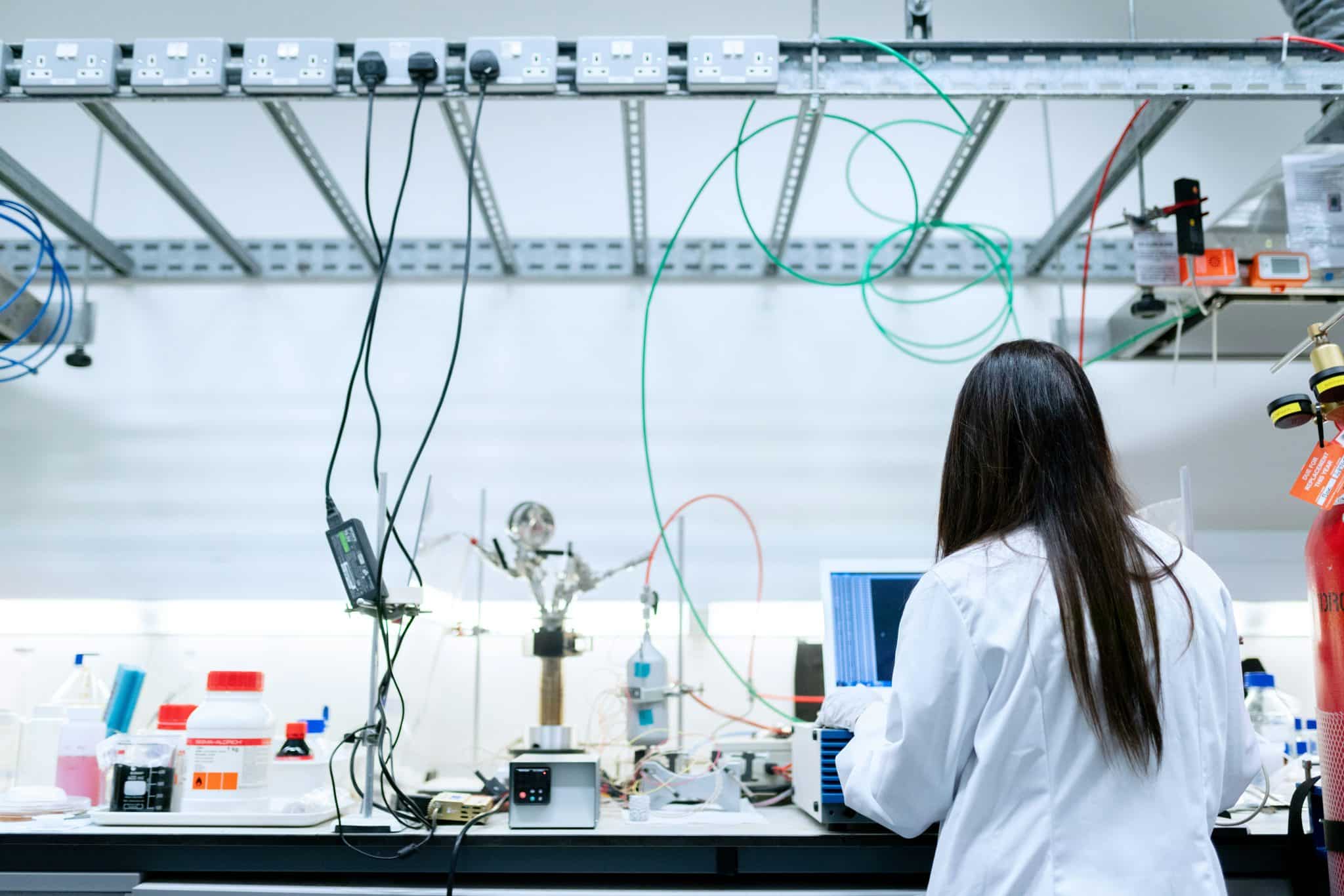
In recent years, colleges and universities have been facing pushback against the funding they receive for research endeavors, and more broadly, the societal benefits of higher education institutions. In 2025, over $3.2 billion in National Institutes of Health (NIH) funding was stripped from universities across the country, affecting both public and private institutions. At a time when research initiatives are facing funding cuts, it is more important than ever to demonstrate the economic and societal value universities generate through research.
The impact of university research extends beyond scientific discovery, supporting economic growth across multiple industries. Research activities at higher education institutions support employment in industries that supply laboratories, equipment, and specialized services. Businesses selling supplies and equipment are directly impacted by the higher ed research industry, and the investments made by institutions to these vendors create new jobs in tandem with the success of the research industry. Many of these purchases of goods and services are made through local vendors – a study by the Institute for Research on Innovation & Science (IRIS) indicates that approximately 30 percent of research-related purchases are made with vendors in the same state as the purchasing university.
A recent trend in this space is the creation of innovation districts, which are concentrated areas where universities, startups, and other companies come together to foster collaboration and idea sharing in the hopes of accelerating progress. As these districts grow, they attract talent, investment, and new businesses that strengthen the local economy. The integration of key amenities such as transit accessibility, retail, and mixed housing with these dense employment centers makes innovation districts an attractive place to live and work. While these areas can be formed in already booming cities, they are a compelling redevelopment option for cities with underutilized or abandoned space. Universities play a large role in the development of innovation districts as anchor institutions that help to supply talent, research capacity, and access to funding.
As higher education faces greater scrutiny, institutions have increasingly sought to highlight the impact that their research efforts have on their local and regional economies. In addition to the standard impact categories of operations, capital, ancillary spending, and wage premium, many of our higher-ed clients have opted to highlight research activities separately to underscore the significance of that arm of their operations. Typically, research spending is modeled in aggregate with other operational spending, but isolating and highlighting research activity provides another key impact number to demonstrate contributions to innovation economies.
In a study focusing on the Eds and Meds sector in Massachusetts, ESI quantified the potential economic activity that a collection of universities lost due to reduced research funding. Massachusetts has been particularly vulnerable to research funding cuts because of its status as a hub for research activity and its strong innovation economy. As of 2025, it was estimated that institutions in Massachusetts will face an annual reduction of $1.3 billion in research funding from the NIH, which results in $2.6 billion of lost potential annual economic activity in the state, and an annual reduction of over $60 million in potential tax revenues as a result of research activities. These losses extend beyond universities themselves, reducing employment for researchers and workers in supporting industries, as well as a reduction in tax revenues that support public services and other state priorities.
University research is not only a driver of scientific discovery, but a foundation for economic growth and regional competitiveness. Research institutions attract talent, support local businesses, encourage entrepreneurship, and generate tax revenues that strengthen public services and infrastructure. The effects extend well beyond campus boundaries, shaping the long-term vitality of entire communities. Sustained support for university research is essential to maintaining competitive, innovative, and economically diverse regions.
Lucie Doran, Analyst | [email protected]
 Lucie’s work focuses on economic impact studies at multiple scales for clients including universities, hospitals, and developers, among other industries. These analyses help clients to quantify their impact on local and regional economies and are often used to secure funding and make the case for the many societal benefits their institutions support. Lucie worked as a research assistant at ESI prior to joining the firm as a full-time analyst. A graduate of Drexel University, she earned bachelor’s degrees in mathematics and economics and received Magna Cum Laude honors.