
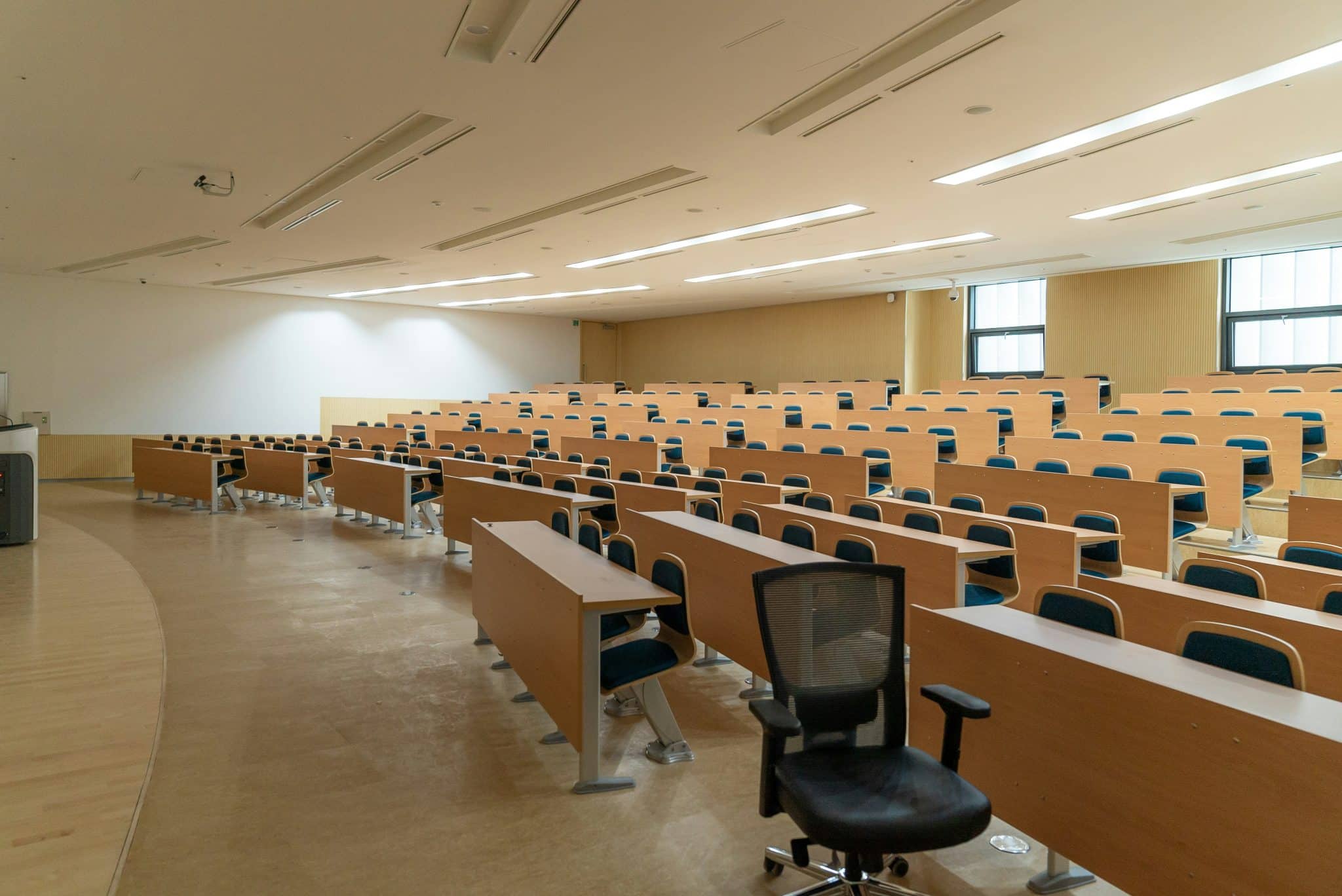
When two universities merge, the press release typically celebrates a new chapter, a stronger institution, and a brighter future. What it rarely mentions is the empty quad left behind: the dorms, dining halls, libraries, athletic fields; often hundreds of acres that no longer needs to function as a center for learning. What happens next is one of the most consequential and least examined questions in higher education today, and the answer has the potential to shape the economic future of the surrounding town for a generation.
Since March 2020, more than 40 nonprofit colleges and universities have announced mergers; and in 2025 alone, at least a dozen public or nonprofit higher education institutions either merged or shut their doors. The drivers are familiar: a shrinking pool of college-age students, persistent operating deficits, deferred maintenance backlogs, and federal policy shifts that have made even well-known institutions more cautious about their balance sheets. Closer to home, the Commonwealth of Pennsylvania has been a national bellwether. Villanova absorbed the closing Cabrini College in 2024 and announced a merger with neighboring Rosemont College in 2025, while Penn State’s Board of Trustees voted to close seven Commonwealth campuses by spring 2027.
What gets less attention than the merger is a question that often determines whether the surrounding community comes out ahead or behind: what happens to the shuttered campus? When two institutions become one, one of them typically has a physical campus that no longer needs to function as a freestanding college. That decision to absorb, divest, or redevelop quietly shapes the economic future of the host town.
Three Paths for the Second Campus
Looking across recent mergers, the receiving institution generally takes one of three approaches.
Absorption and expansion. The most visible path is to integrate the second campus as a satellite of the surviving institution. Villanova’s treatment of the former Cabrini campus is a textbook case. After acquiring the 112-acre Radnor property in 2024, Villanova committed to $75 million in renovations. When the campus reopens as “Villanova University Cabrini Campus” in fall 2026, it will house roughly 900 students, several academic departments, a 100,000-square-foot recreation complex, dining facilities, and renovated athletic spaces. The Rosemont campus is on a similar trajectory, set to become “Villanova University Rosemont Campus” after a transition that begins in 2027.
Divestment. Many institutions cannot afford, or do not need, a second campus. In these cases, the campus property is sold, sometimes into uncertainty. Vermont offers a sobering case study: of four campuses that have closed there since 2019, one was bought by a former reality-TV contestant whose plan for a “work college” never materialized. Another changed hands amid a wire fraud plea. A third was floated as senior housing before being sold to a waste management company. Now plans for the fourth include a luxury resort on the former Southern Vermont College site; however, the years of uncertainty took a toll on Bennington’s economy.
Adaptive reuse. Between full absorption and outright sale lies a third path: thoughtful redevelopment that responds to local needs. When Dana College closed in Blair, Nebraska in 2010, the loss of 150 jobs collided with an existing workforce housing crisis. A blended-finance redevelopment combining state housing funds and below-market financing turned the former campus into Dana Suites, a workforce housing project that has maintained full occupancy with waiting lists and helped local employers attract workers. A community-driven approach was the difference between blight and recovery.
What This Means for the Surrounding Town
It is easy to forget, until a campus closes, just how much economic weight an academic institution carries. They are rarely just colleges or universities; they are typically among the largest employers in their region, and the jobs they support extend well beyond the faculty, staff, and administrators on the payroll. Standard input-output models treat their economic impact as direct, indirect (the suppliers a university buys from), and induced (the spending those workers do at local restaurants, retailers, and services).
When a campus disappears, those layers unwind in reverse. In Aurora, New York, the closure of Wells College took the town’s largest employer with it; and because Wells operated the local water treatment facility and co-managed the community health center, the municipality faced existential questions about basic services. In rural Pennsylvania, state representatives in the districts surrounding Penn State DuBois and Fayette have warned of an “economic development death sentence” if local manufacturing loses its pipeline of trained graduates and the region loses its only four-year degree provider.
This is where the conventional grievance about universities that they do not pay their fair share of property taxes deserves a more careful look; and is why Payments in Lieu of Taxes (PILOT) programs have become a flashpoint in cities from Boston to Philadelphia to Pittsburgh. But the full story looks different than the summary version. Universities and their health systems fund after-school and K-12 enrichment programs, operate free or low-cost health clinics, run community development corporations, anchor public safety partnerships, and also open libraries, athletic facilities, and cultural programming to the public. Many of those services are precisely the ones a municipality would otherwise have to fund itself. The question is rarely whether universities contribute, but whether the contribution is visible, measured, and aligned with what the host community actually needs.
The Strategic Question
For a merging university, the temptation is to treat the second campus as a real estate problem. However, it almost never is. It is a community problem, a programmatic problem, a workforce problem, and a real estate problem, all at once. Decisions about whether to keep, sell, lease, or redevelop a campus ripple outward into local employment, school enrollments, the housing market, and the political relationship between the institution and its neighbors. A campus thoughtfully repositioned as student housing, mixed-use academic space, workforce housing, or a community-serving hub can extend the institution’s mission while strengthening the host town. A campus dumped onto the market without a plan can leave a hole that takes a decade or more to fill.
This intersection between higher education strategy and real estate decision-making is one of the more interesting frontiers in town-gown economics right now. What is the highest and best use of a campus that no longer needs to function as one, given the institution’s mission, the local economy, and the community’s priorities? The answer is rarely obvious, and it is almost never just about the buildings.
The next decade will produce many more of these decisions. The institutions and towns that fare best will be the ones that treat the “other campus” not as a leftover, but as a strategic asset worth thinking about as carefully as the merger itself.
Cassandra Brown, Vice President | [email protected]
 Cassandra Brown is a vice president at ESI, where she leads high-impact economic analysis and strategic consulting for major institutions across the higher education, healthcare, tourism, and life sciences sectors. With almost 20 years of experience in data-driven decision making and organizational leadership, she has established herself as a trusted advisor to universities, corporations, nonprofit, and government agencies.