

Recently, I have found myself humming one of The Rolling Stones’ hit songs – You Can’t Always Get What You Want, as the challenges some of our clients are facing around retail attraction parallel the lyrics to this track.
Countless communities are challenged by higher-than-average retail vacancy, despite the fact that the US vacancy rate is estimated to be around 4.1%.[1] This is especially noticeable in large urban downtown environments, where retail vacancy is at record levels. This is primarily the result of a loss of foot traffic, driven in part by the trend of Work from Home (WFH) and a hybrid workforce, resulting in some companies downsizing their presence. Downtown DC has been hit particularly hard, in part by the trend of Work from Home, but also the loss of the Federal work force which is now largely remote.
The rise of e-commerce is also impacting cities. E-Commerce is here to stay. While still a relatively small percentage of overall retail sales, it has steadily increased over the past ten years, rising to 16.2% of all retail sales in Quarter 3 of 2024.[2] The good news is many online retailers are now opening brick & mortar stores as part of their omni channel marketing strategies.
Over the past decade, paradigm shifts have occurred in the retail industry, influenced by sweeping changes in consumer spending, consumer demo- and psychographics, retail products, market access even the capital markets. The increase in virtual retail makes it increasingly difficult for communities across America to establish and maintain sustainable brick and mortar retail bases. However, with a well-considered retail attraction “battle plan,” a community has the power to influence retail site selection decisions.
I rarely shop online; for me nothing takes the place of a well-designed store. And, when I travel, I explore the local retail. I love small shops, where there are often great finds. I found a wonderful local bookstore in Montgomery, Alabama, with a display of banned books. Fortunately, I already have a copy of The Very Hungry Caterpillar.
On a recent trip to Paris I visited the Galeries Lafeyette, one of Europe’s most spectacular department stores. Once I escaped the tourists taking selfies, I found myself in the women’s ReStore Department (Resale) amidst a mix of merchandise, the likes of which I have never seen in the US, surrounded by beautiful architecture. I am thankful my suitcase had no room, though I did buy an amazing pair of earrings.
While at ICSC in NY last week, I stopped by the Daily Shop, Whole Foods’ new small format store. Whole Foods has branded this concept, one-third the size of a typical store, as the place you do your “daily shop” for groceries. Their growth strategy is targeted at dense urban neighborhoods and consumers who do not shop at one of their traditional stores.
Retail is a critical component of any community. While enhancing quality of life, it also contributes to wealth creation and the local tax base. Where retail is located is also important, as it is often a catalyst for other developments.
Recent research by JLL and McKinsey & Company reveals that while market conditions vary by location, retail spending is expected to increase in 2025 as interest rates fall and consumer confidence rebuilds. Thus, I remain optimistic.
Despite the potential for spending, retail recruitment is a challenge for many cities today. One of the greatest hurdles is creating a balance between the community’s desires and expectations and what is actually achievable. That said, without vision and aspirations, communities might never reach or achieve the ultimate retail mix that advances and enhances quality of life to the level desired.
Not every city can support a glamorous department store or a top brand grocer, but there are ways to activate vacant spaces.

I am a huge fan of Pop-Ups and temporary activations. One of my favorite examples is from Detroit. Several years ago, young fashion designers were offered storefronts to display their designs and promote their collections. The stunning windows drove foot traffic to an underserved neighborhood and helped launch these entrepreneurs. Seattle has flexible pop-up program. Potential tenants can choose from a selection of options even just a window display with a QR code, which leads to a designer’s website.
Even institutional investors are embracing this model. Brookfield offers small tenants a range of short-term leasing options at some of their properties (Pop-ups, RMUs, kiosks, and inline store formats). These are available whether it’s an e-commerce brand looking to build an omnichannel presence, or a small business looking to test out a market, or an individual trying to figure out if they should begin a brick-and-mortar journey.
In the past year I have found myself explaining to clients why they cannot necessarily get what they want. Case studies from my past are useful to show what can be achieved, including one of my favorites about development in DC.
20 years ago, a private client of mine attempted to secure Home Depot as the retail anchor of a mixed-use redevelopment project. Challenges around loading made the deal impossible. Refusing to waiver from his commitment to the neighborhood, he devised an innovative approach with a cluster of tenants which provided the merchandise he promised. It proved to be a far better mix and one with a far better draw. This included the Container Store – which sold home goods, a Best Buy which featured electronics but also sold appliances – a priority for the neighborhood, and a local hardware store, tucked in the basement, which satisfied demand for local contractors and DIYers.
Another example is grocers. Don’t have a Trader Joe’s, Lidl or Whole Foods? Cleveland and Philadelphia are home to two of my favorite local grocers. Heinen’s in CLE, a local grocer, offers an impressive mix of fresh food and prepared food. DiBruno Bros. in PHL features meats, cheeses, fresh produce and a variety of prepared foods.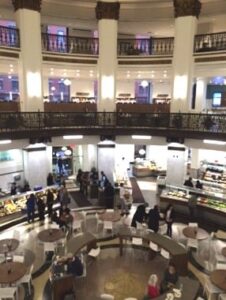
As we move into 2025, I expect I will continue to hum. And as the Stones’ song goes, remember “you can’t always get what you want, but if you try sometime you’ll find you get what you need.”
[1] Note: The national retail vacancy rate has been estimated to be 4.1% for the third consecutive quarter, by Colliers. This low rate is attributed to the strong leasing in suburban markets, and limited consolidations, “moveouts” and new product being built. It does not reflect the actual vacancy in many downtown environments.
[2] US Census, Quarterly Retail Sales, Ecommerce Sales Updates
 Catherine Timko, principal/CEO of The Riddle Company, is an ESI Senior Advisor. Trained as a city planner, much of her work, including with ESI, is focused on retail attraction. She can be reached at [email protected]