

Takeaways from ULI’s 2025 Housing Opportunity Conference
This past February, I had the opportunity to attend the Urban Land Institute’s Housing Opportunity Conference in Atlanta. The Housing Opportunity Conference convenes a mix of housing industry professionals from across the country to learn about cutting-edge research and best industry practices. This year’s conference saw a focus on the efforts to improve the nation’s housing supply in light economic uncertainty; new tools to help local stakeholders understand their housing markets; and trending policy solutions recently leveraged by Atlanta.
Economic Uncertainty in the Housing Market
ULI convenings provide attendees with a deep look at the macroeconomic trends that are impacting the housing market. Many trends were covered, and much focus was paid on the growing uncertainty facing the overall economy, and how it may impact the housing market. Very generally, most leading economists agree that the introduction of tariffs on the country’s largest trade partners and overall trade policy uncertainty will have a deleterious effect on the U.S. economy. While it remains to be seen how the economy will respond if the tariffs are fully enacted, leadings experts from the conference pointed to the likely effect on construction costs – where inputs like imported steel and lumber may see inflationary pressure. Ultimately, these cost premiums would be passed on to consumers – pushing rents and housing prices higher. As the final policy remains in flux, it will be critical for local stakeholders to track how trade and supply chain disruptions may impact their ability to bring new housing supply to their markets in a cost-effective manner.
The 2025 Home Attainability Index
The Home Attainability Index is a data-rich resource from ULI’s Terwilliger Center – updated annually – that allows users to better understand the extent to which a housing market is providing a range of choices attainable to the regional workforce. The tool highlights gaps in home attainability and intraregional disparities in residential markets and can inform federal, state and local housing development, financing and policy decisions. Here are three major takeaways from this year’s update:
I. Cost Burden Growing Across the Country
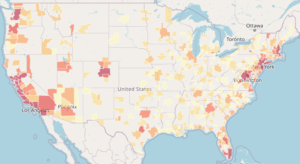
Housing cost burden – defined as when households are paying more than 30 percent of their income on housing – has become increasingly common across the country – even in many historically affordable, non-metropolitan areas. Analyzing cost burden in 2023, the visual below show how the percentage of population facing housing cost-burden has increased significantly across the country – particularly in California, the Sunbelt and the Northeast (where red indicates the strongest rates of population facing cost burden).
II. Down Payment a Growing Barrier to Homeownership
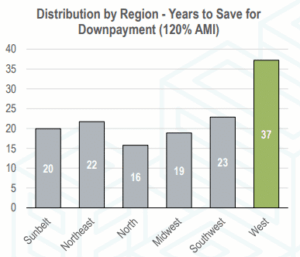
Homeownership – still considered one of the best means to increasing generational and household wealth – is becoming an increasingly difficult opportunity to access. The 2025 analysis found that across the hundred largest metropolitan areas, households earning 120 percent of the area median income must save approximately 4 percent of their household income for – at a minimum – 10 years on average to afford a 10 percent downpayment on the metropolitan area’s median priced home. In some of the least affordable metropolitan areas in the county, that estimate can reach higher than 30 years.
III. Housing Development and Rent Growth
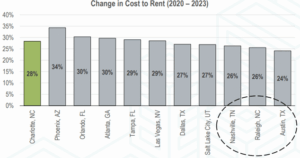
While many variables can impact housing prices, the interaction of housing unit supply and housing demand within a local market is key to understanding the trend in price increases and decreases. Very generally, as the available unit supply within a local area surpasses the demand for housing units, the overall price of housing units will remain flat or fall. Alternatively, if supply remains static or below a local area’s demand for housing units – housing unit prices increase. Confirming this, the 2025 analysis found that markets with significant housing unit production have generally seen lesser rent price increases.
Forward-Thinking Housing Policy in Atlanta
As the conference host city, many of the sessions focused on how Atlanta has been dealing with their housing supply issues. The interventions below highlight two thoughtful innovations to traditional approaches in affordable housing development that could be implemented by other cities across the country:
I. City-Owned Land
City-owned land holds many benefits to affordable housing development, as it can significantly reduce land acquisition costs that often impact a project’s financial feasibility. Atlanta has sought to leverage as much under-utilized city-owned land as possible for the development of housing. For Atlanta, this has meant truly all public land – including land currently utilized by a variety of different city departments, such as the fire department, the school district and the transit authority. Since 2021, 40 public land projects have been undertaken with approximately 10,000 new affordable housing units finished or under construction. One notable project is the redevelopment of Fire Station 15 in Midtown Atlanta. The redevelopment will turn Fire Station 15 into a mixed-use development – providing a redeveloped fire station with a mixed-income residential tower above it.
II. Mixed-Income Development with Public Equity Investment
A growing number of localities – most prominently Montgomery County, Maryland and now Atlanta – have begun using revolving loan funds to finance a portion of the construction of mixed-income housing developments. Functionally, the local authorities – backed by public capital – provide short-term, low-interest mezzanine debt financing, which is repaid as the project shifts to permanent financing. This allows the project to face lower financing costs during construction, and generally, rely on fewer other government subsidies, such as the Low-Income Housing Tax Credit – a valuable but ultimately oversubscribed and subsequently scarce resource. As noted by the Center for Public Enterprise – a leading advocate for this approach – the model additionally helps in today’s difficult and uncertain interest rate environment and can significantly reduce the financial complexity that has historically defined affordable housing capital stacks.
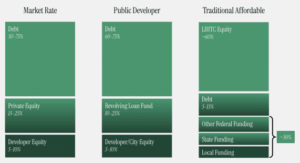
Source: Center for Public Enterprise (2025)
The 2025 ULI Housing Opportunity Conference underscored the urgent need for innovative, data-driven, and locally tailored solutions to address the growing housing affordability crisis in the United States. As economic uncertainty looms and construction costs rise, tools like the Home Attainability Index offer critical insights into market disparities and cost burdens, helping stakeholders make informed decisions. Atlanta’s proactive strategies—leveraging city-owned land and pioneering public equity investments in mixed-income developments—serve as compelling models for other cities seeking to expand affordable housing options. As communities nationwide grapple with housing challenges, the lessons shared at this year’s conference highlight the importance of collaboration, creativity, and commitment to ensuring that housing remains accessible and attainable for all.
Stephen Madsen, Director | [email protected]
 Stephen Madsen is a director at Econsult Solutions, Inc., providing expertise in housing and economic development policy analysis. In 2020, Mr. Madsen earned his Master’s in City and Regional Planning from the Rutgers University Edward J. Bloustein School of Planning and Public Policy. In 2012, Mr. Madsen earned his Bachelor of Arts in Political Science from the College of the Holy Cross.