

The Connection Between Housing Affordability and Economic Development
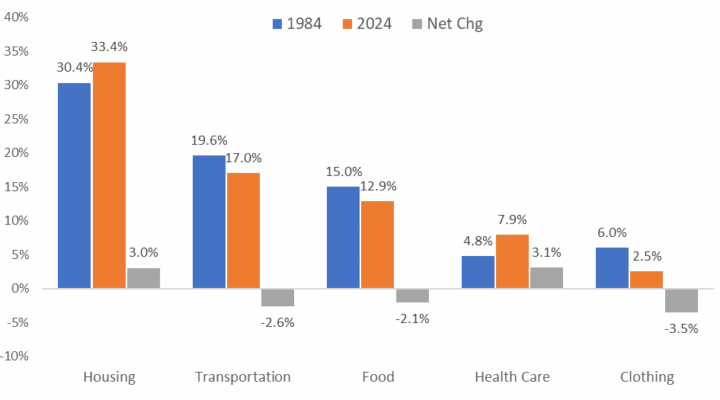
Housing affordability has become an increasingly prominent concern for local and state policymakers in recent years. A comparison of historic data on how U.S. households distribute their spending explains this rising concern. Figure 1 below shows data from the 1984 and 2024 BLS Consumer Expenditures on the share of household spending falling on basic needs. This comparison shows that the share of spending on items like transportation, food, and clothing has fallen in the past 40 years, while spending on health care has risen significantly. The share of spending on housing – the largest category of household expenditures – has risen from 30 to 33 percent of the average family budget.
Figure 1 – Share of Household Expenditures by Major Category, 1984 and 2024
Source: Bureau of Labor Statistics Consumer Expenditure Survey, 1984 and 2024
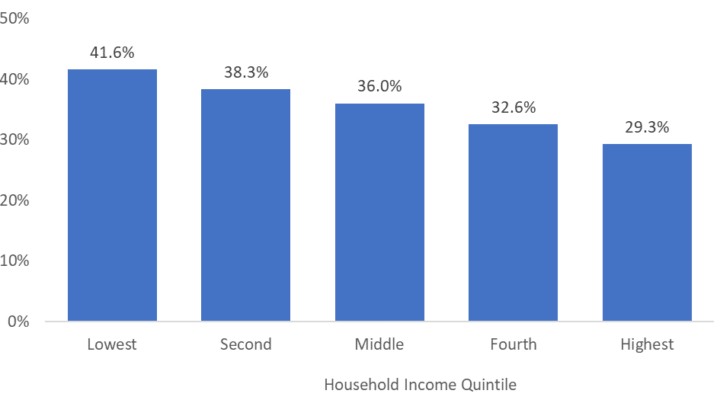
Housing affordability is a concern across the income spectrum, but particularly among lower-income households, who generally spend a larger share of their incomes on basic needs. Figure 2 shows that the share of spending on housing declines as income increases, with households in the lowest income quartile spending 42 percent on their income on housing, and those in the middle quintile spending 36 percent.
Figure 2 – Share of expenditures on Housing by Income Quintile, 2024
From the standpoint of local policy, the rising cost of health care and other potential cost elements like food, fuel and materials fall largely outside of the available levers for local and state government. By contrast, housing and land use decisions are among the primary functions local government. From this perspective, it is no surprise local and state policymakers have increasingly centered on housing affordability as a key issue they can tangibly affect.
ESI’s work at the intersection of policy and economics helps us understand not only the cost-of-living implications of housing affordability, but also its relationship to the economic development objectives of communities, municipalities and regions. While affordable housing and economic development goals and strategies can vary widely, the three intersecting topics below explore the functional connection between these policy areas – speaking to the benefits of a coordinated approach across both fields.
Workforce Access and Retention
Limited housing supply and affordability gaps can lower economic growth by constraining those who can live and work in an area. The misallocation between workforce demand and housing availability costs can weaken productivity, inhibiting the ability of businesses to staff and scale up appropriately, and reducing the viability of a location for business relocation or growth. Without addressing the issue, municipalities and regions may struggle to build the talent pipeline that fuels economic competitiveness over time.
This misalignment can also create practical challenges in implementing economic development strategies. This is especially true for strategies that seek growth in accessible job categories with lower average income levels, such as retail, hospitality, and some facets of health care and social assistance. Without a viable approach to housing affordable, it is difficult to develop a local workforce that can support the growth of these types of industries.
Household Spending Power
Reducing the share of income that is spent on housing frees up disposable income for households to spend in other ways. This allocation improves financial stability and reduces financial stress, but also increased localized demand in areas like food, retail, entertainment and recreation.
One of the primary benefactors of this additional spending power are neighborhood commercial corridors. Additional spending power in neighborhoods in turn supports local businesses and jobs, generating economic development from the ground up.
Neighborhood Stability
Reducing housing cost burdens contributes to neighborhood stability and vibrancy. Beyond increasing household spending power, lower housing costs provide households with additional financial cushion for economic shocks. That stability helps communities reduce vacancy, attract investment, and maintain their tax base.
Neighborhoods can experience positive or negative feedback loops depending on the match between their housing stock and the economic means of potential residents. If unaddressed, mismatches between housing costs and the income levels of residents can lead to cycles of increasing vacancy, deterioration of the housing stock and underinvestment which can become self-reinforcing. By contrast effective housing strategies – both those that make housing production more feasible, and those that help address housing affordability gaps – support strong neighborhoods, continued investment and economic growth.
 Ethan Conner-Ross, Executive Vice President & Principal | [email protected]
Ethan Conner-Ross is an executive vice president and principal at ESI. He leads the firm’s public policy practice area, where he advises state and local governments on issues related to economic insecurity, housing policy, and economic development strategy.
 Stephen Madsen, Director | [email protected]
Stephen Madsen is a director at ESI, specializing in housing and economic development policy analysis. He brings prior experience from the New Jersey Housing and Mortgage Finance Agency and the New York City Economic Development Corporation, where he worked on housing finance, development strategy, and public-sector implementation. At ESI, Stephen supports clients in evaluating housing policies and projects and aligning housing strategies with broader economic development objectives.