

Across the country, cities and counties are rethinking how they work together to address growth, infrastructure, and economic development. Challenges such as housing affordability, mobility, workforce access, and commercial revitalization rarely follow municipal boundaries. Yet planning processes often remain siloed, with jurisdictions pursuing parallel strategies that do not fully reflect how regional economies function.
A recent Baltimore City-County initiative, supported by ESI, offers a glimpse of how this dynamic is changing. While the effort focused on a specific geography, its broader significance lies in how collaboration was structured. The project demonstrated that sustained coordination across jurisdictions is not simply a governance exercise. It can fundamentally reshape how planning decisions are made, how priorities are aligned, and how long-term outcomes are achieved.
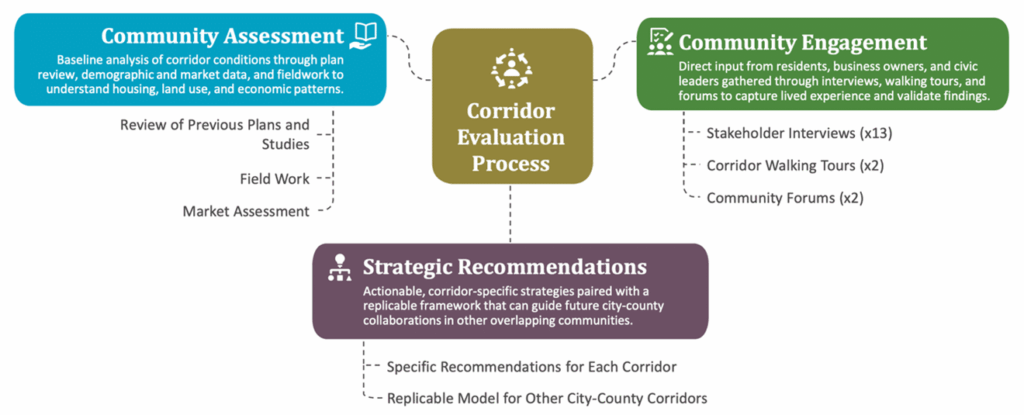
Across the country, similar partnerships are emerging. From joint comprehensive planning in Nebraska’s Lincoln-Lancaster County to coordinated growth strategies in Northeast Austin and Travis County, regions are recognizing that effective planning increasingly depends on collaboration that extends beyond traditional jurisdictional lines.
Why Cross-Jurisdiction Planning Is Gaining Momentum
For decades, cities and counties have operated within distinct planning frameworks shaped by local mandates, funding streams, and political priorities. That structure made sense when economic activity was more geographically contained. Today, however, regional systems are far more interconnected. Residents may live in one jurisdiction, work in another, and rely on services that span multiple governments.
As a result, fragmented planning approaches are becoming harder to sustain. Infrastructure investments, economic development strategies, and land use decisions made in isolation can create unintended consequences just across a border. Recognizing this, many jurisdictions are moving toward coordinated planning models that emphasize shared goals and aligned implementation.
The Lincoln-Lancaster County 2050 Comprehensive Plan illustrates this shift. Rather than maintaining separate visions, the city and county developed a coordinated framework designed to guide growth decisions across the region. Similarly, Northeast Austin and Travis County have launched a joint planning effort that reflects the reality that rapid growth pressures require shared strategies rather than isolated responses.
Communication as the Foundation for Collaboration
One of the most important lessons from the Baltimore City-County effort is that collaboration does not happen automatically. It requires intentional structures that bring agencies together and keep them engaged over time.
A structured communications strategy played a central role in building that foundation. Targeted outreach to municipalities, regional partners, and economic development organizations helped clarify roles and maintain momentum across a complex set of stakeholders. Just as importantly, the process created space for planners and agency staff on both sides of the jurisdictional line to engage directly with one another. These conversations helped shift planning from parallel efforts toward coordinated action.
Rather than treating communication as a final step, the initiative used regular updates and tailored messaging to reinforce a shared narrative around economic opportunity. Agencies were able to compare priorities, align timelines, and identify opportunities for collaboration that might not have emerged through traditional planning processes. Over time, this ongoing dialogue strengthened relationships between jurisdictions and positioned collaboration itself as a lasting outcome of the effort.
Moving Beyond Parallel Planning
Cross-jurisdiction partnerships often require balancing different perspectives. Cities may focus on neighborhood revitalization and public realm improvements, while counties frequently prioritize infrastructure systems, workforce access, or regional growth management. Without intentional coordination, these priorities can compete rather than reinforce one another.
The Baltimore initiative addressed this challenge by framing collaboration around shared economic outcomes. Conversations emphasized how coordinated planning could advance multiple goals at once, from supporting local businesses to improving access to jobs. This approach helped stakeholders move beyond questions of jurisdictional ownership and toward a more integrated understanding of regional planning.
Other regions are formalizing similar models. In Paducah and McCracken County, Kentucky, a long-term interlocal agreement established a unified comprehensive plan guiding land use, transportation, housing, and economic development decisions across both jurisdictions. By adopting a shared framework, the city and county created consistency in policy direction while maintaining distinct local identities.
These examples suggest that successful collaboration depends as much on process as on policy. Joint planning frameworks, regular communication, and shared implementation strategies help transform collaboration from a temporary partnership into a durable planning model.
What This Means for the Future of Planning
Taken together, these efforts point to a broader shift in how cities and communities approach planning. Cross-jurisdiction collaboration is no longer limited to occasional coordination meetings. It is becoming a central mechanism for addressing complex regional challenges.
Three themes stand out:
- First, collaboration is moving from informal coordination toward more structured partnerships, including joint planning processes and interlocal agreements.
- Second, communication strategies are emerging as essential tools for sustaining collaboration. Structured engagement helps jurisdictions align priorities and maintain shared momentum.
- Third, accessibility matters. Translating technical planning work into clear, practical messaging allows a broader range of stakeholders to participate in collaborative processes, strengthening transparency and trust.
A Shared Path Forward
City-county partnerships will not eliminate local decision-making, but they are increasingly shaping how regions plan for growth and investment. As jurisdictions experiment with new governance models, the most effective collaborations may be those that treat coordination as an ongoing process rather than a one-time initiative.
The Baltimore City-County effort demonstrates how structured communication can create lasting relationships across jurisdictional lines. Comparable initiatives in Austin, Lincoln-Lancaster County, and Paducah-McCracken County reinforce that this is part of a broader evolution in planning practice.
Ultimately, the future of planning may depend less on where jurisdictional lines are drawn and more on how cities and counties choose to work across them. When collaboration becomes embedded in the planning process, regions are better positioned to translate shared challenges into shared opportunity.
Emily Goldstein, Associate Director | [email protected]
 Emily Goldstein is an associate director at ESI and leads economic analysis and strategic advisory work for public agencies, nonprofit organizations, and private sector clients. She manages this range of projects across the firm’s economic development, government and public policy, and equity and inclusion practice areas. With nearly a decade of experience in economic policy, urban planning, and data-driven decision-making, helping clients evaluate investment strategies, policy choices, and planning initiatives.