
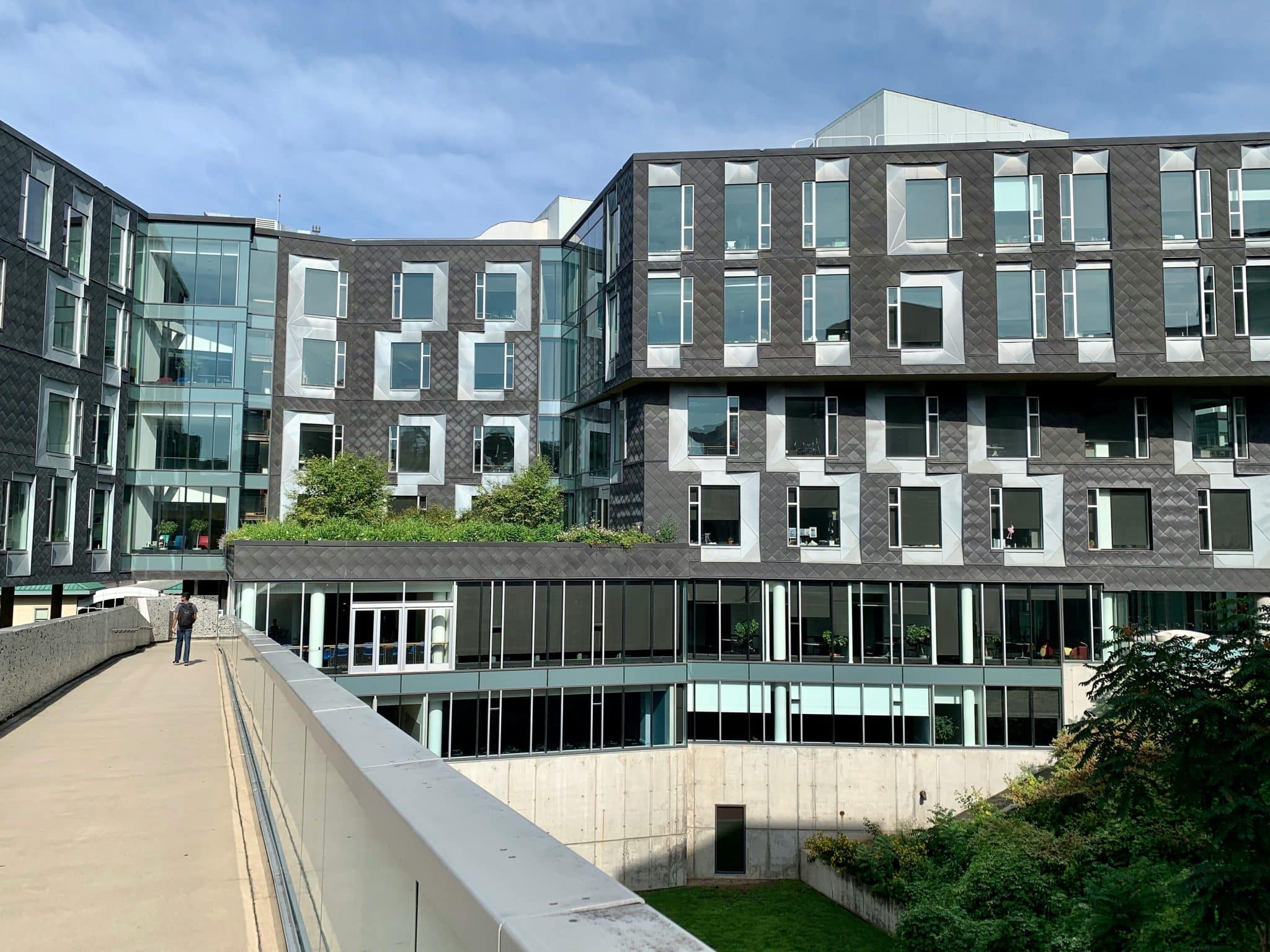
Universities as a Producer of Value
In most regions that have one, a research university ranks among the largest economic engines around. It is a major employer and landowner, and its impacts typically run into billions of dollars and tens of thousands of jobs. The University of Pennsylvania accounts for $30.4 billion in economic activity statewide. Johns Hopkins accounts for roughly $47 billion in economic activity across Maryland and supports about 149,000 jobs.
Figures like these capture the magnitude of impact an institution creates, but not the form that value takes close to home. Impact can be measured at every scale, from the state down to the city. Whether the gains take a concentrated, local form often tends to depend on whether there’s a place built nearby to hold them, and on the public investment that helps build it.
Few institutions concentrate talent, funding, and research dollars the way a major university does, and the effects can reshape a city. Carnegie Mellon is one example: ESI estimated its annual impact in Pennsylvania at $2.7 billion, most of it around Pittsburgh, and pointed to its early lead in robotics and computer science as the first-mover advantage that helped turn Pittsburgh into a hub of innovation.
Innovation Districts Capture Impact Close to Home
Commercialization takes deliberate work; a breakthrough in a campus lab can sit for years without reaching the communities around it. That value can spill over across a region or take hold where it was created. Concentrating that value is the basic premise of an innovation district. According to the 2014 Brookings report, “The Rise of Innovation Districts: A New Geography of Innovation in America,” these districts form around an anchor institution, which the authors define as a research university or a research-heavy hospital. So, the university is already the anchor, and the district is the structure built around it to hold what the anchor produces.
In a working district, research helps to establish new companies, employment opportunities, and capital that circulates more closely, and the same dynamic surfaces in different cities.
Philadelphia’s University City is the closest example. Firms tied to the University City Science Center incubator have been linked to nearly $7.6 billion in economic activity across Greater Philadelphia each year, supporting more than 29,000 jobs. That figure is a local-capture story because of where the activity stays: the jobs and companies concentrate in the region, keeping most of the value created in the labs close to home.
Johns Hopkins Technology Ventures has supported over 130 startups that together raised $4.4 billion in venture capital, and 43 percent of that money has stayed in Baltimore rather than following founders elsewhere. That retained capital, along with the companies and talent that come with it, is exactly the value a district is built to hold.
Public Investment Makes Impact Possible and Proves Itself Over Time
Public investment shows up at both ends of this chain. An innovation district does not fund itself, and neither does the research that is performed there, which is where public dollars enter the conversation. At the research end, federal and state grants support much of the discovery in the first place. Those flows have tightened recently, with consequences for universities and their workforces that a recent Present Value post explores further.
On the other end, public programs help pay for the places that capture the value. Pennsylvania has Ben Franklin Technology Partners, a state-funded program that invests early-stage capital in young technology companies and backs the incubators that give them lab space. New Jersey awarded the Health + Life Sciences Exchange its first transformative Aspire tax credit. The State of Minnesota, City of Rochester, and Olmstead County all continue to invest money into Destination Medical Center.
Both ends need public dollars. The payoff is too uncertain and far off for private capital to take on early research or shared district infrastructure on its own. Public spending absorbs risk that private capital avoids, and that willingness is often what lets a district exist in the first place.
Further, by anchoring a district, universities help pull private and institutional money into the place itself, into housing, retail, transit, and public space. Those amenities make a district somewhere people want to work and stay, which helps attract and retain the talent and capital that give the district its value. The gains are not confined to the district either; as its quality of life and amenities improve, so do those of the surrounding community.
Measuring Whether the Investment Works
The returns on public investment show up at different points along the chain, from research funding to commercialization to regional growth, and they build up over years. A point-in-time impact study captures the scale of that activity and where it lands in a given year. To judge a long-term public investment, you also want to see how those figures move over time, since the trend is what shows whether the early spending paid off.
The 10-year look back at Destination Medical Center does exactly this: it measures what public investment returned over a decade following the value of those dollars from the initial outlay through to their impact on the region. That kind of shift takes years to surface, the same way Pittsburgh’s move from an industrial to knowledge economy did. Public investment can advance innovation. Knowing whether it did in a given location takes both a snapshot review of today’s efforts, as well as a long-term assessment that examines whether early spending paid off. Measured that way, the question is not only whether a district sparked innovation, but how far those investments moved a region toward its broader economic development goals.
Anjana Balaji, Senior Analyst | [email protected]
 As a senior analyst at ESI, Anjana Balaji provides economic and fiscal impact analyses, real estate pro forma modeling, market research, and planning support. Her work spans the firm’s universities and hospitals, economic development, government and public policy, and real estate practices. Since joining ESI as a research assistant, Anjana has contributed to dozens of client engagements across multiple regions, bringing analytical depth to questions at the intersection of economics, planning, and public policy.